Remembering the Dromcollogher Cinema Fire: The Aftermath of ‘The Burning’

Aftermath of the fire (INDH620). Photo donated to the National Library of Ireland by Independent Newspapers (Ireland) Limited
One hundred years later, contemporary newspaper reports and photographs in the collections of the National Library of Ireland help us remember the tragedy and its aftermath.
On the evening of 5 September 1926, around 150 people gathered in a makeshift cinema in Dromcollogher, Co. Limerick to watch a programme of films. A short film, False Alarm, was followed by the main feature, The Decoy.
What happened that evening would become one of the most devastating disasters in the history of Irish cinema.
The fire began when a candle fell and ignited the highly flammable nitrate film, the material used in early motion picture. The fire spread with terrifying speed through the temporary cinema, which was located upstairs in a large two-storey wooden shed. There was only one means of entering and leaving the building: a ladder.
As panic took hold, those closest to the exit managed to escape, but many further inside became trapped. Iron bars on the windows prevented people from escaping that way, while the intensity of the fire’s blaze made rescue efforts almost impossible. A contemporary newspaper reported that “in the final horror the floor collapsed”.
Forty-eight people died, around one tenth of the population of Dromcollogher. More than half of the victims were under 25, including 15 children. The youngest were two seven-year-olds.
The scale of the loss was almost unimaginable for such a small community. One family was wiped out in the disaster: father and national school teacher Jeremiah Buckley, his wife Ellen, their daughter Bridie, Ellen’s sister Kate Wall, and their maid, Nora Kirwan, all died in the fire. The Evening Herald described this as “one of the most appalling features of the tragedy” in its report of 6 September 1926.
The disaster became known locally as ‘The Burning’, a name that has remained in use through the generations.
A community in mourning
In the immediate aftermath, the people of Dromcollogher faced the terrible task of identifying and burying the dead.
A vigil was kept throughout the night, while local pubs closed as the community mourned. The following day, the remains of the victims were placed in coffins. It was decided that they would be buried together in a mass grave in the grounds of the church.
The funeral drew enormous attention from across Ireland. President W. T. Cosgrave attended, while messages of sympathy arrived from King George V, church leaders, trade unions, county councils and other organisations.
A national relief fund to support those affected by the disaster was established by President Cosgrave. Its work continued for decades, with the final payments not being made until 1958.
The tragedy prompted important questions about the circumstances surrounding the fire. At the time, village halls, shops and other buildings were frequently adapted for use as temporary cinemas, particularly in rural Ireland. Film prints were often borrowed from cinemas in larger towns and cities and transported to smaller communities for screenings.
Contemporary reports stated that the reels shown in Dromcollogher had been obtained from Cork without permission. The film cans had reportedly been left behind so that their absence would not be noticed, leaving the highly flammable nitrate film exposed. Once ignited, nitrate film could burn with extraordinary intensity.
The informal nature of these makeshift cinemas also meant that safety standards required in licensed premises were not always observed. In Dromcollogher, the lack of an adequate exit combined with the exposed film reel proved catastrophic.
Questions of responsibility
In the days following the fire, attention turned to those involved in organising and operating the cinema.
The projectionist, Patrick Downing, and the organiser, William Babe Forde, were arrested initially and charged with manslaughter. However, the State ultimately did not proceed with the case.
Photographs in the National Library of Ireland’s Independent Newspapers Photographic Collection document some of the people and places involved in the aftermath. One striking image appears to show Downing and Forde following the funerals, with one of the men wearing a bandage on his hand.
Other photographs record the burned-out building, the funeral procession moving through Dromcollogher, crowds gathering in the streets, police officers, the closed shops of the village and the community grave where the victims were laid to rest.
Together, these photographs provide a powerful visual record of a community attempting to come to terms with an almost unimaginable loss.
A tragedy remembered
The Dromcollogher Cinema Fire remains Ireland’s worst cinema fire. Today, a public library stands on the site of the disaster, serving as a memorial to the 48 people who lost their lives. Their names are inscribed on the base of a cross in the nearby graveyard.

Courtesy of Dromcollogher Community Council
The disaster received extensive coverage in the days and weeks following the fire. Reports appeared not only in local and national Irish newspapers, but also in Northern Irish and international publications.
“The agony inside and outside the doomed building wrung every heart.” – Cardinal O’Donnell, quoted in the Limerick Leader
For historians, researchers and family members today, these contemporary accounts offer something particularly valuable: a record of events as they unfolded. They capture the shock and grief of the time, the names of the victims, the funeral arrangements, the questions surrounding the fire and the response of the wider community.
Among the National Library of Ireland’s newspaper holdings, The Limerick Leader provides particularly detailed coverage of the disaster and its aftermath. Digitised issues available to consult in the NLI’s Main Reading Room allow researchers to follow the story through contemporary reporting
The NLI also holds a number of photographs relating to the Dromcollogher fire in the Independent Newspapers Photographic Collection, including images of the funerals, the burned-out cinema, the community grave and people affected by the disaster.
The Library’s Prints & Drawings Collection also contains a striking contemporary Italian print depicting the fire, Quando il cinematografo di Drumcollogher (Irlanda) divenne un rogo. Anyone interested can request to view our holdings, once they have their free Reader’s Card.
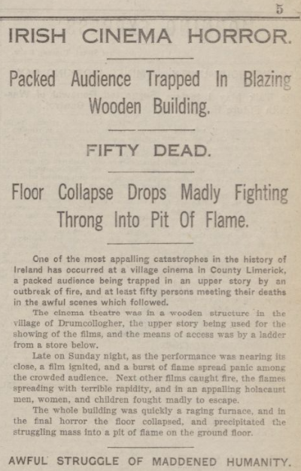
Sheffield Daily Telegraph, Tuesday 7th September 1926
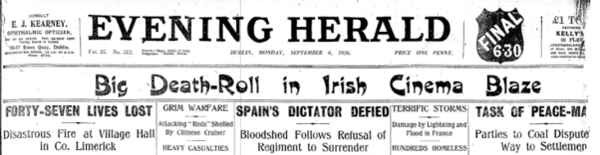
Evening Herald, Monday September 6th, 1926
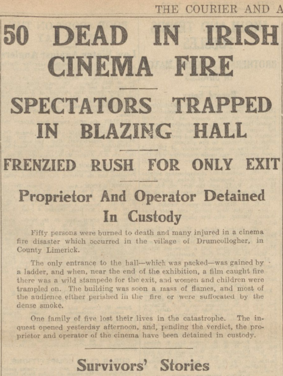
Dundee Courier, Scotland, Tuesday 7th September 1926
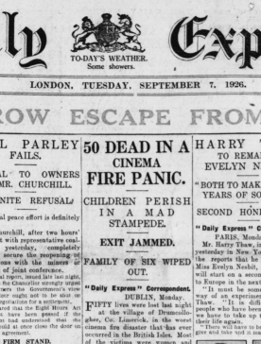
Daily Express, London, Tuesday 7th September 1926
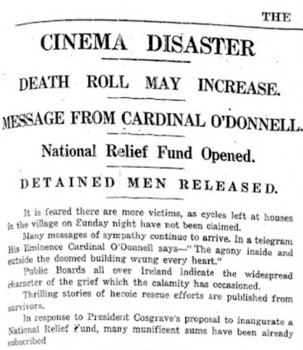
Cork Examiner, Thursday 9th September 1926

Limerick Leader, Monday 6th September, 1926
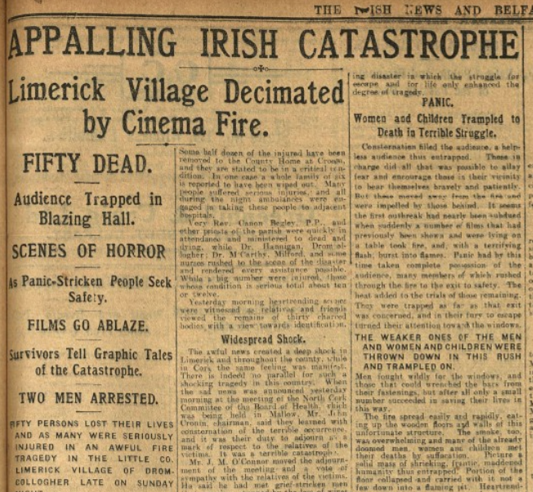
Irish News (Belfast), Tuesday September 7th 1926
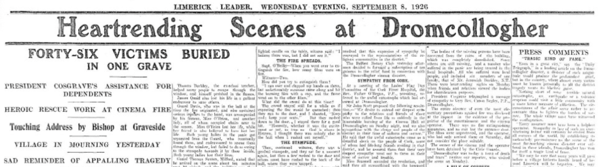
Limerick Leader, Wednesday 8th September 1926
Exploring the story through the NLI collections
A century after the Dromcollogher Cinema Fire, the collections of the National Library of Ireland allow us to look beyond the bare facts of the tragedy and explore how it was experienced and remembered.
Newspapers in particular are extraordinary sources for researching historical events. They can reveal not only what happened, but how people at the time understood an event: who was affected, how communities responded, what questions were being asked and how stories developed over subsequent days and weeks.
The National Library of Ireland holds extensive newspaper collections in digital, microfilm and hardcopy formats. These include local and national publications covering events throughout Ireland and beyond.
If you are researching the Dromcollogher Cinema Fire, or another significant event in Irish history, we welcome you to explore the Library’s collections in our reading rooms.
Collection highlights
- The Limerick Leader — contemporary local reporting on the Dromcollogher fire and its aftermath.
- Independent Newspapers Photographic Collection — photographs documenting the fire, funerals, victims and community response.
- Prints & Drawings Collection — a contemporary Italian print depicting the Dromcollogher cinema fire.
The National Library of Ireland remembers the 48 people who lost their lives in Dromcollogher on 5 September 1926, and the community that endured the devastating aftermath of ‘The Burning’.
Discover more

