Made to Degrade: Preparing bound 20th century newspapers for digitisation

Miscellaneous Newspapers Vol.6. Newspapers housed inside a library binding.
Alongside extensive newspaper runs, the collection also contains a number of rare and unique items. On occasion, the National Library of Ireland received only one or two issues of a particular newspaper title, and these isolated editions remain the sole examples of that title held within the collection. In the 1960s these single issues, which differed in subject and publication date, were bound together in six volumes entitled Miscellaneous Newspapers. Due to the rare and fragile nature of these issues, they were prioritised for conservation treatment and digitisation.
Miscellaneous Newspapers Volume 6 which contained 55 newspapers published in Ireland between 1915-44 was sent to the Library’s conservation studio for treatment prior to digitisation. There were several things to do first to prepare the newspapers for the digitisation process, a process that often requires intensive prolonged handling of fragile historic objects.
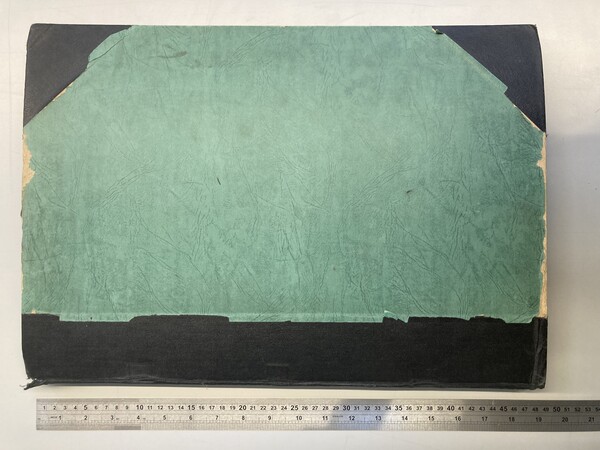
Miscellaneous Newspapers Vol.6
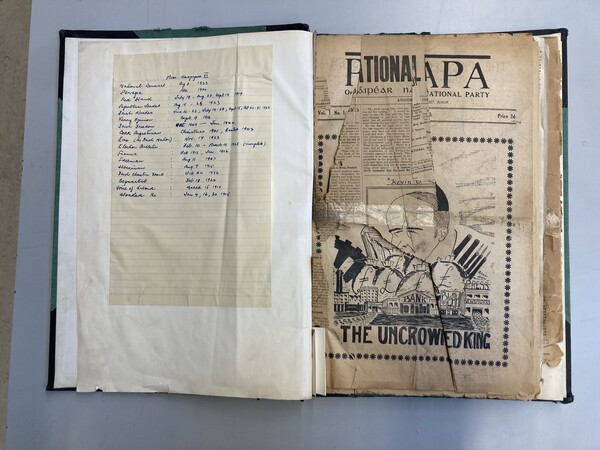
Miscellaneous Newspapers Vol.6. Newspapers housed inside a library binding.
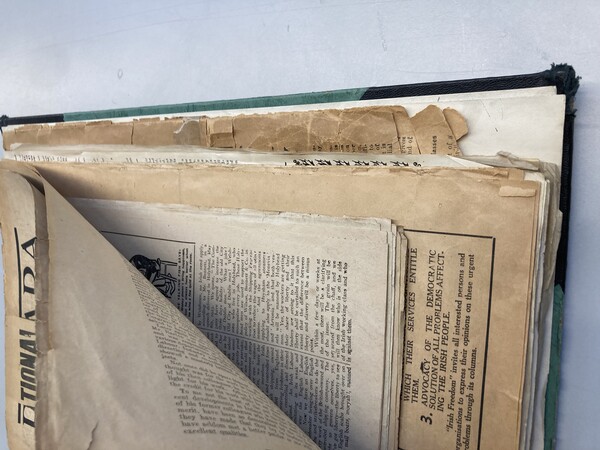
Miscellaneous Newspapers Vol.6. Newspapers housed inside a library binding
Newspaper degradation and storage
Newspapers are inherently short-lived materials. In the twentieth century they were made from mechanical woodpulp which contained much lignin and created paper that deteriorates easily over time, especially if stored in unfavourable environmental conditions. Paper fibres will become acidic which cause them to degrade, the paper can turn brown, become brittle or very soft and tears easily. Newspaper printing ink sits mostly on the surface of the paper, making it liable to smudge. The newspaper printers and publishers did not see these issues as problematic because the papers were never meant to last more than a day or two. They did not foresee that a century later there would be a demand to read their newspapers. One of the ways to safeguard the content of newspapers today is to digitise but sometimes they first need to be prepared and repaired by a conservator.
Many libraries tried to efficiently organise the thousands of loose newspapers in their collections and minimise their storage space by attaching stacks of individual papers, by order of title and date, into structured bindings called ‘library bindings’. However, they did not know that in solving one problem they created another. These machine-sewn bindings could have considerable negative impacts on the newspapers housed within them.
Damage
Miscellaneous Newspapers Volume 6 was an example of the potential damage caused by mid-century library bindings. The machine stab sewing along the centre folds (gutter) of the papers caused some text to be unreadable and the strong thread at great risk of tearing through the weakened paper when pages were turned. There were also lots of tears along the edges throughout, with some papers in complete fragments. Someone in the past had tried to fix some tears with tape (not advisable!). The only way to digitise the newspapers safely and prevent further damage was to remove the binding and separate the papers from one another.
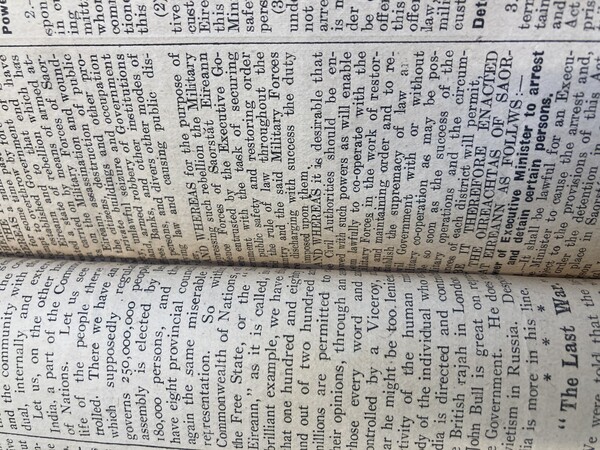
Sewing cuts off some text
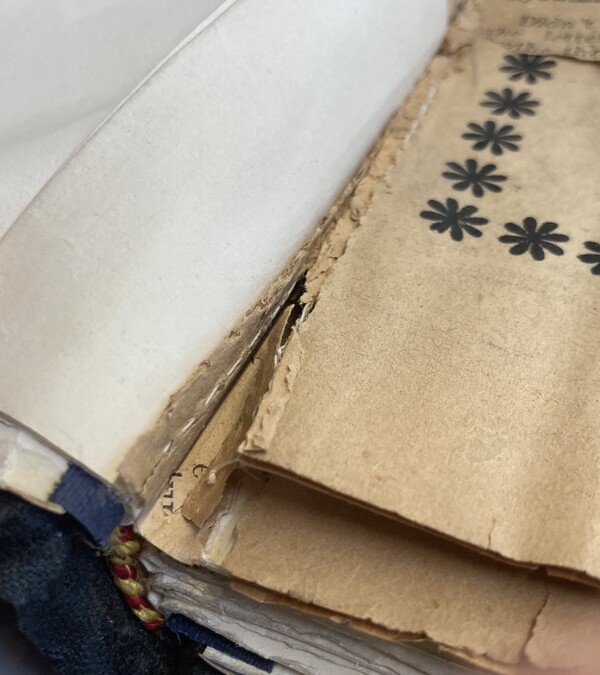
Degraded papers easily torn out
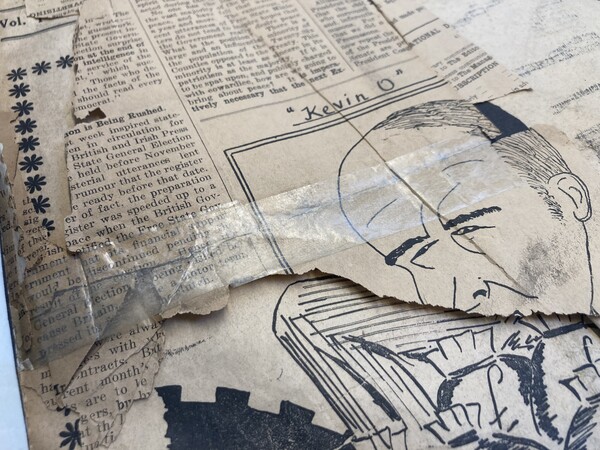
Tears and old repairs
Conservation treatment
The cover was cut away but the stack of newspapers remained stuck together along the spine because a strong adhesive had been liberally applied by the binder in the 1960s. Using strong adhesive on weak paper does not end well. Laponite gel was used to soften and remove the old adhesive, then a sharp pointed scalpel carefully removed the sewing thread. Creases in each newspaper were flattened out with a heated spatula while tears and any losses of paper along the centre folds were repaired by brushing methylcellulose (a clear gel-like adhesive) through strips of 2gsm Japanese tissue paper (a very fine lightweight paper) [1]. These repair materials were chosen based on tests done beforehand to find the most suitable thickness and colour of repair paper, and concentration of quick drying adhesive (to prevent paper distortions and to enable efficient repair of the many tears). Lastly the newspapers were given individual archival acid-free folders.
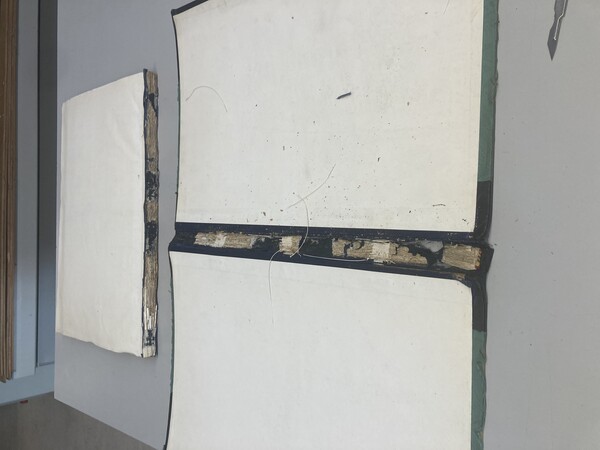
Cover removed
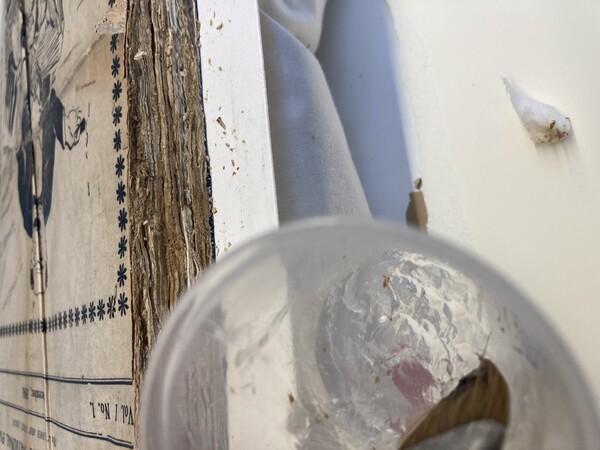
Old adhesive along the stack spine removed
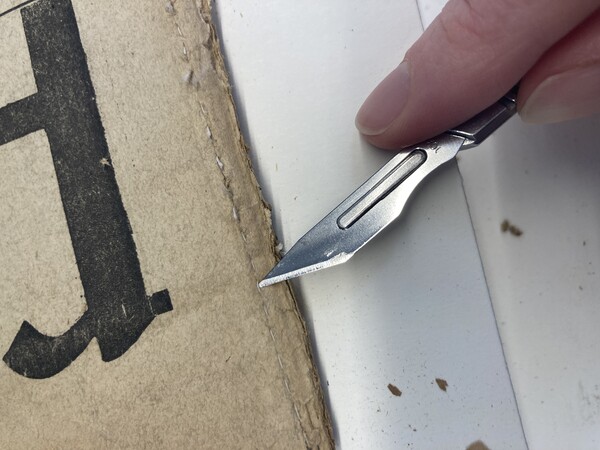
Old sewing cut away
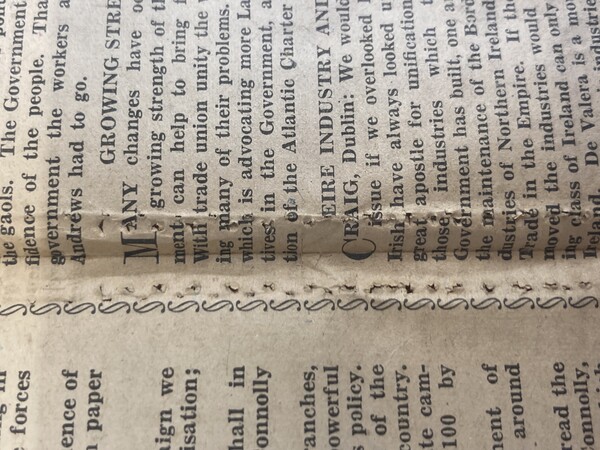
Text visible once again
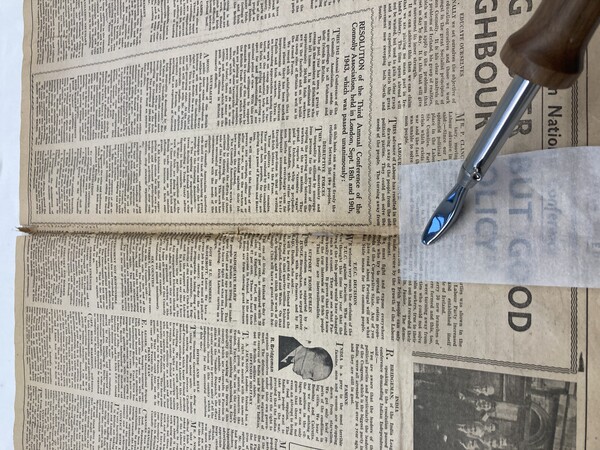
Flattening creases
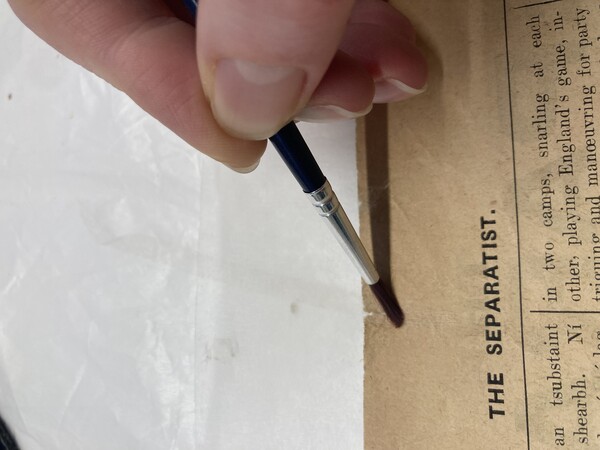
Repairing tears with Japanese tissue paper

Newspaper before conservation treatment

Newspaper after conservation treatment

Newspaper before conservation treatment

Newspaper after conservation treatment

New archival acid-free housing will improve long term preservation
After the conservation treatment of Miscellaneous Newspapers Volume 6, all text is visible, the newspapers are much easier to handle and can go through the digitisation process with minimal risk of further damage occurring.
In large collections it may not be possible to disbind all newspapers from their library bindings as each one can take weeks of conservation treatment. Treatments are prioritised based on the newspapers’ importance and the degree of harm the binding poses to them. Twentieth-century ‘made to degrade’ newspapers can present many challenges for those caring for them, but the fascinating glimpses into the past they can offer us today makes it worth the effort.
The following newspapers from Miscellaneous Newspapers Volume 6 have been digitised and are available on the NLI website:
Irish Christian Front Holdings: Irish Christian Front. :: Library Catalog
Republican Leader Holdings: The Republican Leader. :: Library Catalog
Kerry Opinion Holdings: Kerry Opinion. :: Library Catalog
Penapa Holdings: Penapa : :: Library Catalog
Cork Augustinian Holdings: Cork Augustinian. :: Library Catalog
References
[1] Hutchison, Claire. “Safeguarding Scotland’s Newspapers: A Collaborative Approach to Preservation and Access”, IFLA International News Media Conference 2024. Safeguarding Scotland's Newspapers: A Collaborative Approach to Preservation and Access
Many thanks to Maria Montcalm and Siobhán O’Donovan at the NLI for their helpful contributions to this blog post.
Discover more

